Development / ROBLOX
Roblox event connections: avoid adding another listener every time a menu opens
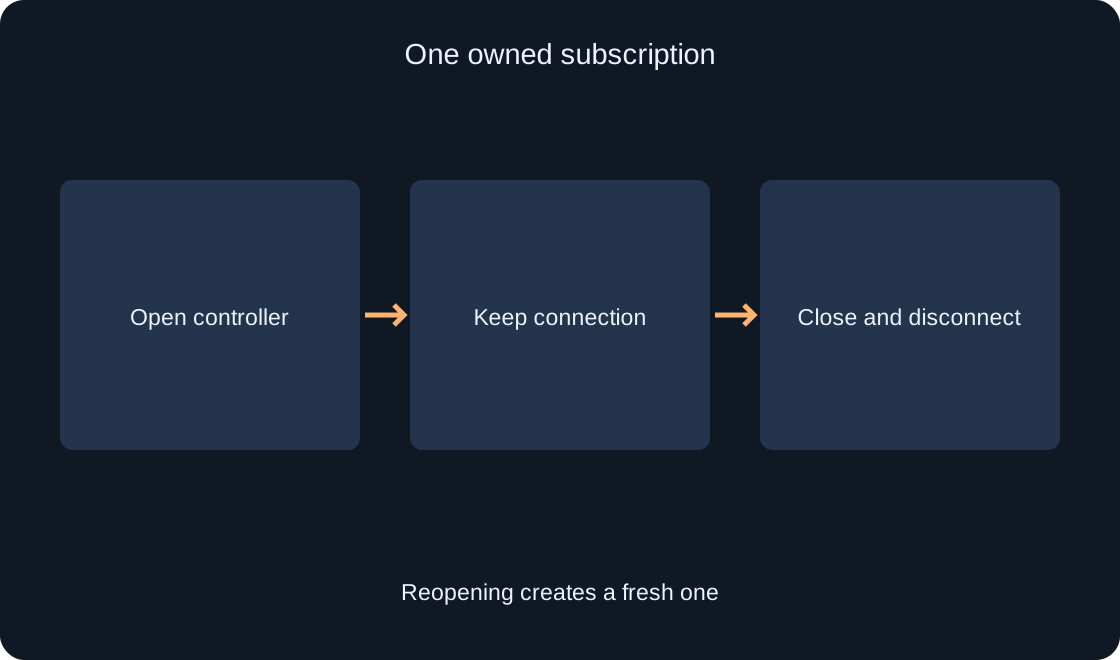
Follow one owned subscription through creation, reopening, disconnection and a fresh opening. An original Studio experiment compares three active listeners with one managed connection and separately checks Once.
Choose one failure mechanism to investigate #
Imagine a temporary help panel that responds to an event. Its controller connects a new function whenever the panel opens but leaves the previous subscription alive. After several openings, one event may invoke several functions. This is a possible failure mechanism, rather than a diagnosis of every existing button. First identify which function creates the subscription and which component is responsible for ending it.
The exercise does not create an actual menu or click its button. The functions openPanel and closePanel represent an imaginary controller lifecycle, while an isolated BindableEvent supplies the signal. This lets us test connection ownership without building interface artwork or changing published games. Testing a real panel remains a separate integration step even when this original assertion suite has already passed.
Separate the event from its connection #
The official documentation describes Connect as a way to attach a function to an event. It returns an RBXScriptConnection object. Keeping that object allows the owner to disconnect the particular subscription through Disconnect. The signal, callback function and returned connection are different things. A variable containing the function itself is not automatically a reference to the connection object.
In our panel exercise, the controller owns currentConnection. It knows where the subscription is created and uses the same saved reference when closing. Avoid scattering creation across unrelated functions without an owner. One field is enough for this contract: it either holds the current connection or becomes nil after cleanup. That small convention makes the complete lifecycle traceable from beginning to end.
 Open full-size image ↗
Reproduce three unwanted listeners #
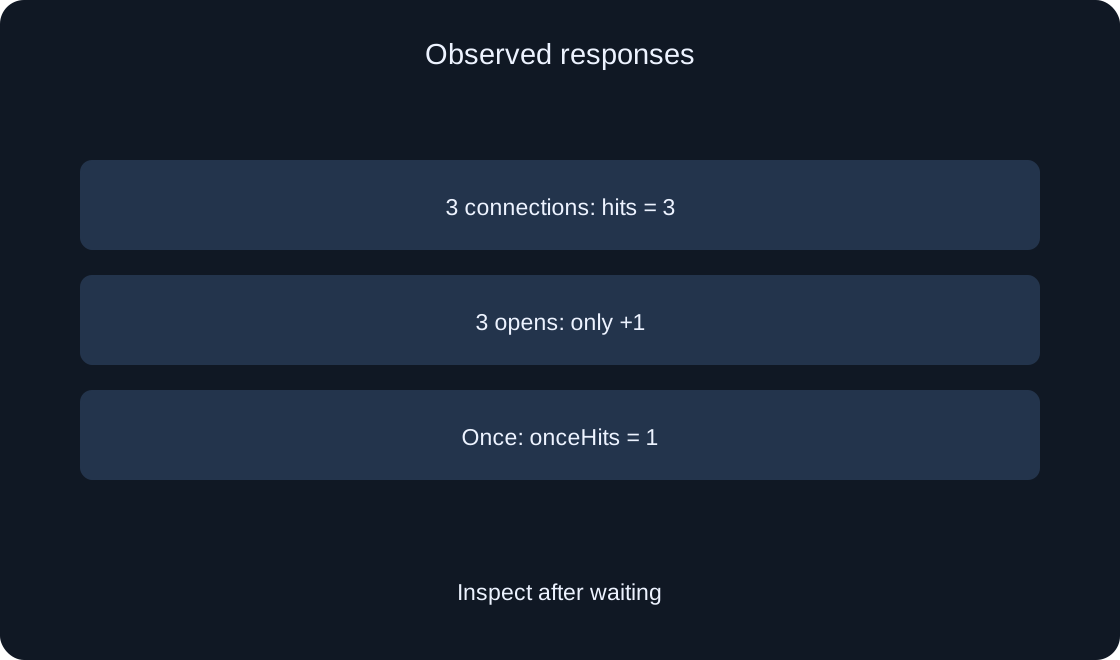
The first part of the original test creates three connections to one BindableEvent. Each callback increments the shared hits counter. The event then fires once. After waiting for processing, hits must equal three. This checks that three active subscriptions produce three callbacks in this isolated scenario. It does not pretend to reproduce a broken button inside a particular existing experience.
Save each returned connection in the duplicates table so that all listeners created by this comparison can be disconnected afterwards. The baseline makes the difference between the unmanaged and managed designs reproducible. Do not label the subscription count as the number of player clicks. There is one event fire and three separately connected functions; those are two different counts with different meanings.
-- Original isolated engine experiment, not an existing-game script.
local signalOwner = Instance.new("BindableEvent")
local hits = 0
local duplicates = {}
for i = 1, 3 do
    duplicates[i] = signalOwner.Event:Connect(function()
        hits += 1
    end)
end
signalOwner:Fire()
task.wait()
assert(hits == 3, "Three live subscriptions must make three callbacks")
for _, connection in duplicates do
    connection:Disconnect()
    assert(connection.Connected == false)
end
signalOwner:Fire()
task.wait()
assert(hits == 3, "Disconnected listeners must not receive a new fire")

local currentConnection
local function closePanel()
    if currentConnection then
        currentConnection:Disconnect()
        currentConnection = nil
    end
end
local function openPanel()
    closePanel()
    currentConnection = signalOwner.Event:Connect(function()
        hits += 1
    end)
end
openPanel()
openPanel()
openPanel()
signalOwner:Fire()
task.wait()
assert(hits == 4, "Reopening must leave only one listener")
closePanel()
closePanel()
signalOwner:Fire()
task.wait()
assert(hits == 4, "Repeated cleanup must be safe and stop new callbacks")
openPanel()
signalOwner:Fire()
task.wait()
assert(hits == 5, "A fresh panel must work after cleanup")
closePanel()

local onceHits = 0
local onceConnection = signalOwner.Event:Once(function()
    onceHits += 1
end)
signalOwner:Fire()
signalOwner:Fire()
task.wait()
assert(onceHits == 1, "Once must handle only the first invocation")
assert(onceConnection.Connected == false)
signalOwner:Destroy()
print("GUIDEBOOK_CONNECTIONS_ENGINE_PASS hits=5 once=1")
Check explicit disconnection #
After the first fire, the test calls Disconnect on each of the three saved objects. It checks Connected==false for every connection. Another Fire followed by a wait must leave hits at three. We therefore verify that a subsequent event does not reach those disconnected listeners. Merely setting a variable to nil while forgetting to disconnect the object would be a different operation.
Disconnect the controller's owned subscription first, then release its saved reference. Avoid disconnecting unrelated connections owned by another system. In a real interface, recording the owner beside the creation site helps make cleanup understandable. The purpose is to finish one component's work, rather than globally prevent every event listener in the project from receiving signals.
Make reopening an owned operation #
Our original openPanel calls closePanel before creating a new subscription and storing it in currentConnection. Three consecutive openPanel calls consequently leave one active listener. The next Fire increases hits from three to four. This is a check for one additional callback, rather than a claim that the complete experiment has executed only one callback since it began.
That behavior fits our contract of one current panel controller. It is not a universal architecture: several independent panels may require separate owners and references. Define the intended number of active subscriptions before choosing a helper. Then verify it through an observable outcome. A short implementation or familiar function name does not demonstrate that the correct number of listeners exists.
Make repeated cleanup safe #
The closePanel function checks whether currentConnection exists. If so, it disconnects the subscription and sets the field to nil. A second call does not attempt to use a released reference. The test calls closePanel twice, then verifies that another event does not change hits. This checks repeated teardown of our controller; it is not a comprehensive test of every possible interface lifecycle failure.
Next, openPanel runs again. A Fire must increase hits to five before the final cleanup. This extra step matters because stopping callbacks is insufficient if the controller can never be created again. Check both directions: teardown ends the old response, and a newly opened controller responds exactly once according to the chosen contract. Treat those as separate expectations in the input sequence.
 Open full-size image ↗
Use Once for the first invocation #
The official guide offers Once when a callback is needed for the first event invocation only. A separate test section creates onceConnection and a fresh onceHits counter. The event fires twice. After waiting, onceHits must equal one and Connected must be false. This result was obtained in actual Roblox Studio with an isolated BindableEvent, rather than a substitute synchronous event model.
The first signal invocation is not necessarily the first suitable occurrence in your domain. If a callback checks another condition, decide whether it should keep listening after an unsuitable input. Do not hide that decision behind the name Once. A one-time successful action and the first signal regardless of its arguments can require different designs and a different set of expectations.
Respect event processing order #
The assertions inspect results after task.wait following Fire. They do not assume that the callback has completed on the very next line. The official deferred-event documentation separately explains queues and resumption points. Incrementing a variable synchronously inside a homemade model would not prove identical engine behavior. That is why this article uses a small actual Roblox API experiment for its confirmed results.
Do not assume that Destroy and Disconnect have identical effects in every pending-callback situation either. The official deferred section distinguishes explicit disconnection from destruction when calls are already queued. Our suite checks subsequent fires after cleanup and the Once case. It does not cover every queue, already running function or parallel handler. Those scenarios need separate examples before making broader claims.
Verify the real panel as an integration step #
For later integration, write a sequence: create the controller, open it repeatedly, fire the event, close twice, fire after closing and reopen. Handle UI-object destruction and already started work as additional cases. If the reaction count differs, compare connection creation with the intended lifecycle before introducing a delay or debounce. A time limit may hide the symptom without correcting ownership.
A rate limiter answers how many actions are allowed over time. Connection ownership answers how many listeners exist and when their work ends. These mechanisms do not replace each other. There are no network requests, rewards, saved records or purchases in this exercise. When adding them later, create their own result checks rather than extending evidence from this local test into a claim about the entire game.
| Stage | Expected |
|---|---|
| Three listeners | hits = 3 |
| After Disconnect | hits remains 3 |
| Repeated opening | hits = 4 |
| Double cleanup | hits remains 4 |
Keep the confirmed result reproducible #
The corrected experiment completed with GUIDEBOOK_CONNECTIONS_ENGINE_PASS hits=5 once=1 in Studio Output. That line follows assertions for three listeners, their disconnection, owned reopening, safe cleanup and Once. The teaching source preserves the exact operations, and its verification record keeps the source checksum. The total of five belongs to successive stages of the complete experiment, rather than one player action.
For another developer, keep the source, expected line, call sequence and verification limits together. Do not call this a finished panel test: there is no panel in the experiment. The scratch project is separate from published games, and a real interface check remains the next task. A precise record makes the failure mechanism repeatable and the proposed lifecycle easier to adapt without overstating what was tested.
| Boundary | Coverage |
|---|---|
| Fresh panel | hits = 5 |
| Once | One callback |
| Interface | GUI tested separately |
| Queues | Not comprehensive |
Original sources
Roblox Creator Hub — EventsRoblox — RBXScriptConnection
Roblox — RBXScriptSignal
Roblox — Deferred engine events