Development / ROBLOX
The platform left before the jump: a story about readable moving obstacles
A hypothetical teaching story about pauses, boarding and recovering an attempt. Examine what a player can understand, then plan separate checks of the cycle, passenger transport and observations from several clients.
 Open full-size image ↗
1. A platform appeared, but no timetable did #
Imagine a fictional prototype: Ira approaches a gap, sees a nearby platform and prepares to jump. While she turns the camera, the platform starts moving. Her jump targets the place where its surface was a moment earlier. This is a hypothetical design scenario, rather than a report from our games, a real review or a completed test.
The first question is not why the player was slow. A nearby platform could reasonably appear available. Write the intended expectation: a newcomer can distinguish safe waiting, boarding and movement. If those states are invisible, a more precise animation alone does not explain the rule. The obstacle needs a clear agreement with the player.
2. Separate boarding from passenger transport #
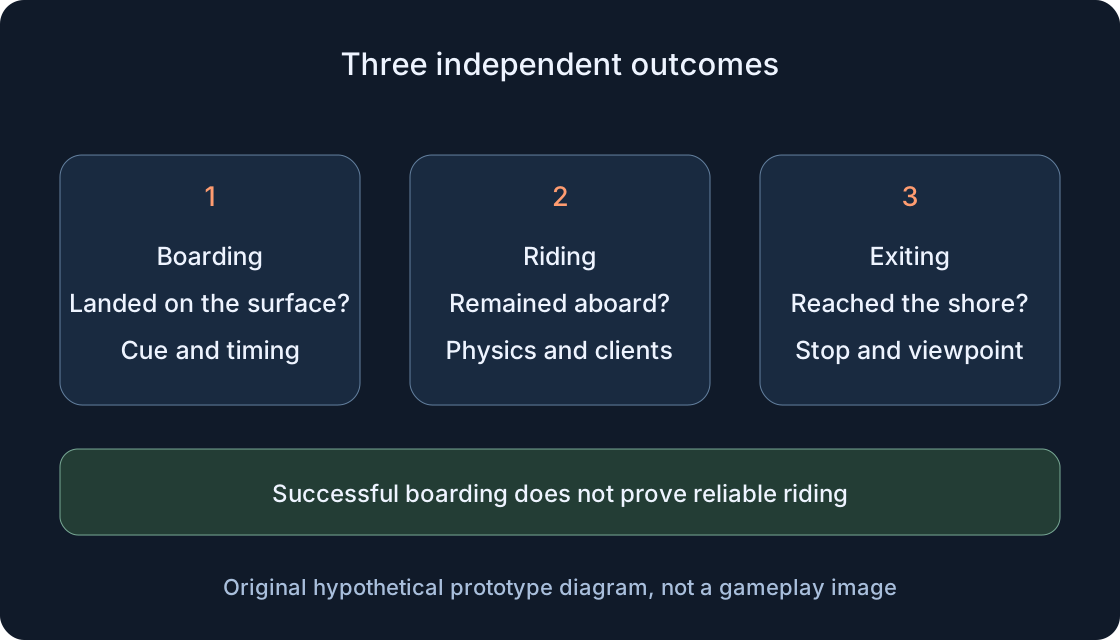
There are several tasks: wait for the platform, land on it, remain aboard while it moves, and step onto a stationary destination. Calling them all a jump hides useful distinctions. This story first addresses understandable boarding. Reliable transport is a separate technical question, which a beautiful trajectory of an empty platform cannot prove.
For a small prototype, propose a broad waiting area, one platform and an exit area. Decide whether the player should ride standing or jump across a moving object. Here the intention is board, ride and exit, not a claim about existing Roblox behaviour. A 12-stud travel route does not require a 12-stud jump; the boarding gap needs its own accessibility check.
3. Provide a place to observe calmly #
The player should be able to watch a complete cycle without standing on a dangerous edge. Proposed initial dimensions are a stationary 10 × 10-stud waiting area and an 8 × 8 platform. They are starting dimensions for evaluation, not measured guarantees. Leave room to rotate the camera and skip a departure without immediately meeting another player or the moving object.
Distinguish waiting space from the boarding point through floor shape and a small landmark. Do not require constant forward movement while someone learns the cycle. Record where they stop, whether they see the return, and whether they understand another trip will come. Before observation, these are questions rather than conclusions about players.
4. Describe the whole cycle #
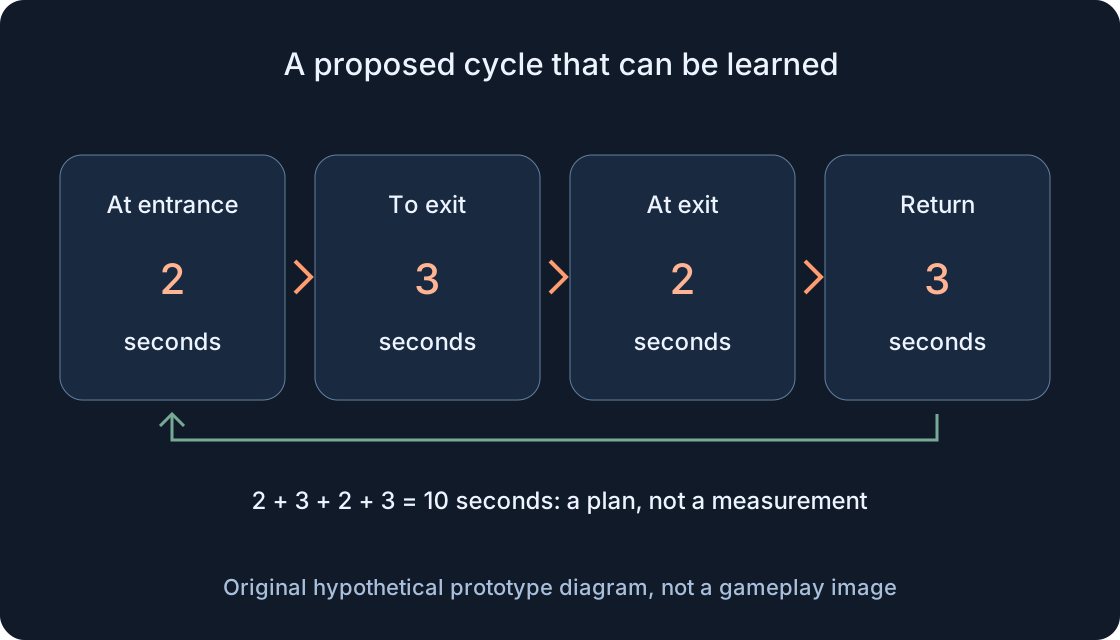
Propose four states: stop at the entrance, travel to the exit, stop at the exit, return. The first table assigns 2, 3, 2 and 3 seconds, totalling 10 seconds. That is a suggested timetable, not recorded platform timing. Implementation still needs to confirm arrival at the intended points and the actual stop durations.
A person arriving halfway through travel does not necessarily wait exactly ten seconds; waiting depends on phase. Do not display an unchanging ten-second departure countdown. Start with visible repetition and clear endpoints. A later countdown must follow the mechanism state rather than an independent decoration. Compare one added stop first, then the other, to judge their purposes separately.
| State | Proposed duration | Player task | Still to check |
|---|---|---|---|
| Entrance stop | 2 seconds | Prepare to board | Signal matches actual stop |
| Travel to exit | 3 seconds | Remain on the platform | Transport and client observations |
| Exit stop | 2 seconds | Move to stationary ground | Accessible exit and viewpoint |
| Return | 3 seconds | Wait on shore for another trip | Returning surface is visible |
5. Announce departure without a puzzle #
Propose a boarding sign with three understandable states: wait, board, departure. Add a symbol and short wording alongside colour. In this practice plan, the last half-second of the stop can provide a warning. It is included within the two-second stop, not secretly added to it. That interval still needs evaluation with the chosen camera and device.
The warning must not promise a safe jump until the final instant. It communicates a closing window; acceptable actions depend on checked mechanics. Do not run the sign on its own repeating schedule, or it may permit boarding after the surface leaves. Define and check the correspondence. If sound supplements it, retain a visible cue for players without audio.
6. Check different arrival phases and viewpoints #
In the next hypothetical episode, Ira arrives during the return while another fictional player sees the end of departure. Both need to understand where to wait and what happens next. Do not check only from the beginning of a cycle: people arrive after loading, another route or recovery. One successful boarding attempt at a favourable moment does not cover them.
Plan an arrival in every phase with an ordinary camera. On a phone, adjusting the viewpoint while preparing movement deserves a separate check. Do not time the window only around the author's keyboard skill. If decoration or the character obscures the platform, record a viewing problem. A pause does not remove physical occlusion.
7. Separate a trajectory from physical behaviour #
Current documentation says Anchored prevents physics from moving a part, but CFrame or Position can still change. TweenService interpolates properties; that does not establish reliable character transport. A moving anchored-platform prototype therefore needs a passenger check separate from its animation.
Another architecture uses a physical assembly and mover constraints: AlignPosition applies force towards a target, while LinearVelocity maintains velocity through force. Choosing them requires consideration of connections, orientation and observed mechanism behaviour, not merely substituting names. This story supplies no transport script. Agree an architecture with the developer, then check standing, jumping, exiting and collisions. Do not permanently attach a character to hide issues; restored free movement also belongs in the design.
 Open full-size image ↗
8. One client is not the whole experience #
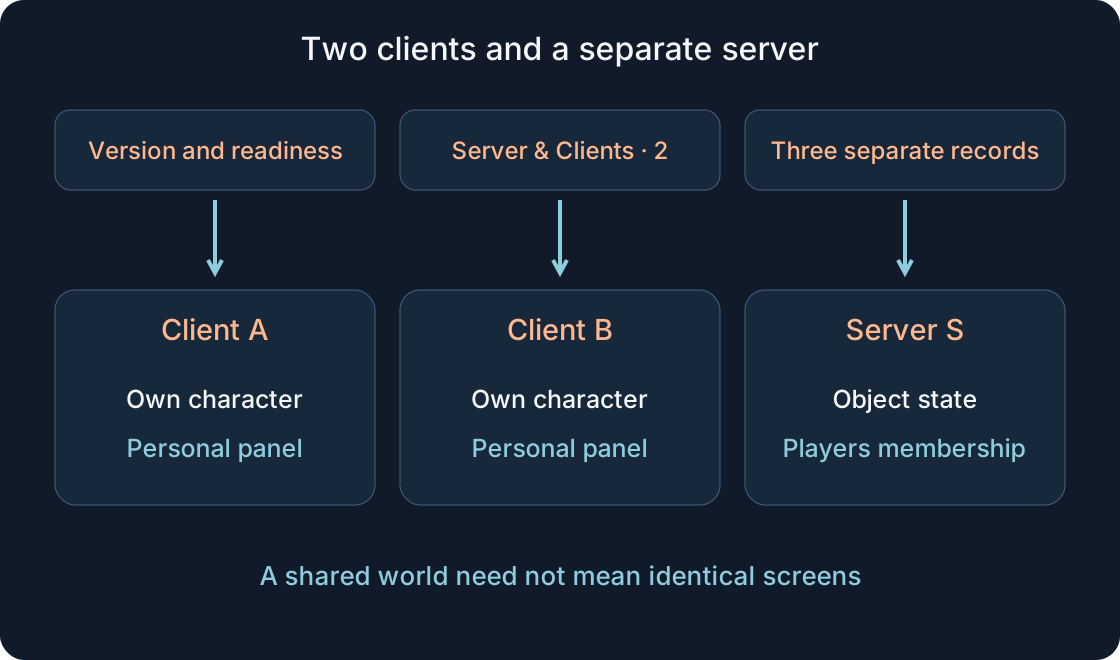
Server and clients participate in networked physics. Anchored parts are server-owned; unanchored parts can receive automatic simulation ownership. This is a design boundary, not a universal instruction to assign ownership manually and consider the problem solved. The movement architecture needs to identify where state is set and how participants observe it.
Plan two roles: passenger and shore observer, then swap them. Compare surface position, boarding signal and exit moment. Smooth local movement does not prove matching observations. Do not alter another game's ownership for this story. Record a mismatch with conditions for the mechanism developer. Two-player checking cannot cover every network condition, but is more informative than watching an empty platform.
9. Give a miss a clear continuation #
In our fictional story Ira misses. The continuation should show where she returns and how to try again without guessing the rule anew. Define a safe recovery area near the waiting space and a separate return mechanism. This is a design requirement, not a complete saving, respawn or checkpoint system.
Check whether the recovered player can watch the current cycle instead of appearing on a moving surface just before departure. Decide whether the shared platform keeps moving during one person's failure. Automatically restarting it for everyone may interrupt another passenger. A full scene restart is separate. Record recovery, retry and new-entry rules; a returned character alone does not establish progress saved between sessions.
10. Compare changes in sequence #
Proposed baseline A travels three seconds each way without stops. B adds only a two-second entrance stop, making an eight-second cycle. C adds an exit stop to B, producing the suggested ten seconds. Separate variant D returns to B and adds only a state marker. These are comparison plans, not published improvement results.
Keep dimensions, camera and transport mechanism constant when studying a pause. The longer cycle is a consequence of the added stop, not an independent speed adjustment. Record understanding of the next trip, boarding decisions and the point of a miss. Record attempt counts rather than inventing them. A transport fault needs its own correction and checking; signal readability does not prove stable physics.
11. Fill the matrix after observing #
The second table lists conditions and questions with an empty actual-result column. It covers arrival phases, boarding, passenger and observer, phone and recovery. For each check, record A/B/C/D, device, date, arrival phase and a concrete observation. A documented attempt to board during return because the sign was hidden is more useful than simply saying the player was confused.
Do not calculate success rates without actual attempt counts and a clear definition of success. Boarding, riding safely and exiting independently are distinct outcomes. Record unexpected cases instead of selecting favourable examples. Until performed, the matrix remains a plan. Reading documentation or comparing a diagram is not a Roblox, phone or passenger-physics test.
| Condition | Question | Actual result |
|---|---|---|
| Arrival in each of four phases | Is waiting and boarding understandable? | |
| Boarding early and late in the stop | Which cue is visible and where is contact? | |
| Standing and jumping on moving surface | Does the intended transport hold? | |
| Passenger and observer, then swap | Do states and exit moment match? | |
| Phone with ordinary camera | Can the cue be seen while preparing movement? | |
| Miss and retry | Is recovery safe and current cycle clear? | |
| Second passenger and full restart | Does the rule remain valid for participants? |
12. End with a decision that can be checked #
This hypothetical story ends with a design decision, not a claim that everyone now jumps correctly: a visible cycle, safe waiting, boarding and exit windows, a matching cue and understandable recovery. Each needs a later observed outcome. Keep the variants and blank matrix with the prototype so another developer sees both intention and unfinished checking.
For a handover, describe the problem in one sentence, name the single changed cause and identify the movement architecture. Include only your own permitted images if you later perform checks; do not present a drawing as gameplay. Choose the next step from viewing, timing or transport observations. A readable obstacle lets players learn and developers explain misses through concrete conditions.
Original sources
Roblox Creator Hub — Parts, physical properties and AnchoredRoblox Creator Hub — BasePart Anchored and transform changes
Roblox Creator Hub — TweenService property interpolation
Roblox Creator Hub — Mover constraints
Roblox Creator Hub — Assemblies
Roblox Creator Hub — Network ownership